
You looked in the mirror this morning and something felt off. Maybe one side of your lips sits higher than the other. Maybe there's a small bump near your cheekbone that wasn't there a few weeks ago, or your jawline looks subtly lopsided in photos even though you swear you held your face the same way on both sides. If you've had dermal filler in the last few months, this unevenness isn't in your head — and it isn't something you have to live with until it wears off on its own.
Dissolvable fillers made from hyaluronic acid are popular precisely because they're reversible. But "reversible" only matters if you know the correction exists and understand how it works. Here's what's actually going on, and what fixing it looks like.
**Why Filler Settles Unevenly in the First Place**
Facial tissue isn't symmetrical to begin with — most people have one side of their face that's naturally slightly different from the other in bone structure, muscle movement, and fat distribution. When filler is placed, even with careful technique, it can settle differently depending on how you sleep, how you chew, how much you move that side of your face, and how your body metabolizes the product over time.
Sometimes the unevenness shows up immediately after injection due to swelling that resolves on its own within a week or two. But if it's been several weeks and one side still looks fuller, lumpier, or more defined than the other, that's not swelling anymore — that's the filler itself sitting unevenly. We cover more on the biology behind this in our piece on why filler can behave unpredictably once it's injected.
Migration is another common culprit. Filler placed near the lips or tear troughs can shift toward areas with more tissue movement, creating a puffiness or asymmetry that wasn't the original goal. If this sounds familiar around your under-eye area specifically, you may find our article on tear trough filler migration directly relevant.
**Hyaluronidase: The Enzyme That Resets the Canvas**
Hyaluronidase is an enzyme that breaks down hyaluronic acid — the same substance most dermal fillers are made from. When injected directly into the area of concern, it dissolves the filler, typically over 24 to 48 hours, though you may notice softening within hours. It doesn't damage surrounding tissue or your body's own naturally occurring hyaluronic acid in any lasting way, which is part of why it's considered such a safe, well-established correction tool.
For a true asymmetry correction, your provider won't necessarily dissolve everything. In many cases, a small, precise amount of hyaluronidase is used to soften just the area that's too full or too raised, bringing both sides back into balance without starting from zero. This is a nuanced skill — it requires someone who understands facial anatomy well enough to know exactly how much enzyme to use and exactly where. For more on when a full dissolve versus a partial correction makes sense, take a look at our guide on dissolving old filler with hyaluronidase.
**What the Correction Appointment Actually Looks Like**
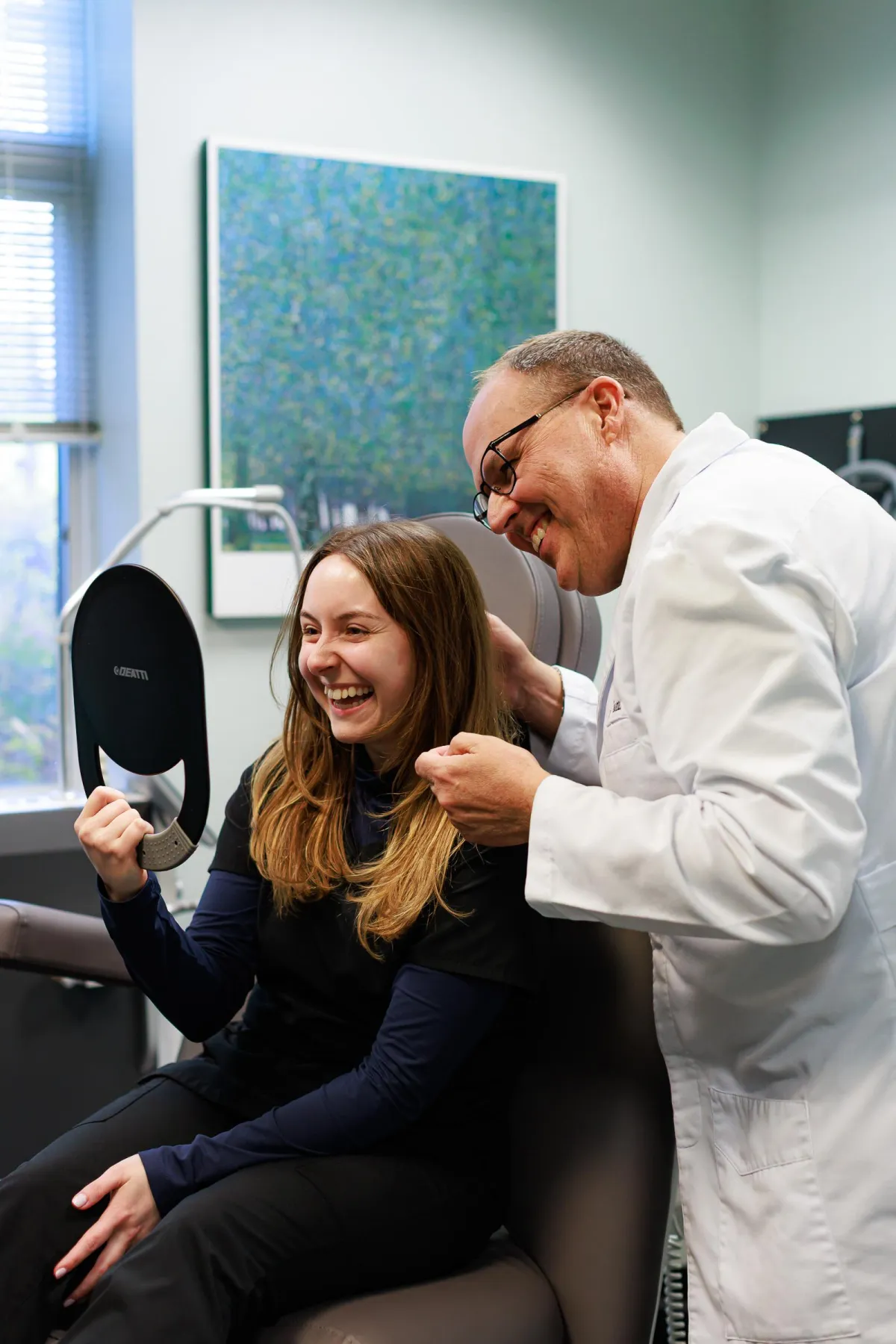
A hyaluronidase correction appointment is quick — often 15 to 30 minutes, depending on how many areas need attention. Dr. Thomas will examine your face in natural light, sometimes photographing both sides to compare objectively (what looks uneven in a mirror can look different in a photo, and vice versa). After discussing exactly what's bothering you and what balanced should look like for your specific face, the enzyme is injected with a fine needle directly into the area of concern.
Mild swelling or tenderness at the injection site is normal for a day or two. Most patients see visible softening within 24 hours and final results within 48 to 72 hours. If your original filler was a biostimulator rather than hyaluronic acid-based, hyaluronidase won't dissolve it — this is an important distinction to clarify with your provider before you book, since not every filler responds to the same correction.
**What Hyaluronidase Correction Costs**
Pricing for hyaluronidase correction depends on how much product needs to be dissolved and how many areas are involved. A small, targeted correction — softening one lump or balancing one side of the lips, for example — typically costs less than a full dissolve of an entire treatment area. Because every case is different, the most accurate way to understand your cost is an in-person consultation where Dr. Thomas can assess exactly what correction is needed. What we can tell you is that this is never a treatment where more product means better value — the goal is precision, not volume.
**When to Seek Correction vs. When to Wait**
Not every asymmetry needs immediate correction. If it's been less than two weeks since your injection, some unevenness may still resolve as swelling settles and the filler integrates with your tissue. But if it's been a month or longer and you're still seeing a noticeable difference between the two sides — or if you're seeing lumps, firmness, or discoloration — that's worth having evaluated. Discoloration in particular, especially a bluish tint under thin skin, can be a sign of the Tyndall effect, which we explain in our article on under-eye filler and the Tyndall effect.
If swelling, warmth, or firmness seems to be getting worse rather than better, or if you notice swollen glands near your jaw or neck, it's worth ruling out other causes before assuming it's simply uneven settling — our post on swollen lymph nodes after filler walks through what's typical and what warrants a closer look.
**You Don't Have to Live With a Face That Doesn't Feel Like Yours**
This is the part we want you to hear clearly: asking for a correction isn't an overreaction, and it isn't admitting something went "wrong." Filler settles the way it settles, and sometimes it needs a second, more precise hand to finish the job the way it was meant to look. Dr. Thomas has spent over 30 years learning facial anatomy well enough to know not just where to add volume, but where to carefully take it away — and patients consistently tell us that what they appreciate most is that results here enhance their features "without ever looking overdone."
If something about your filler results has felt off since the day the swelling went down, you deserve an honest, unhurried conversation about what's possible. That's what a consultation at Physician Artistry is for — not a sales pitch, but a real assessment from a physician who will tell you exactly what he sees and exactly what he'd do about it.

Start your transformation today!
Schedule your complimentary consultation with our friendly and knowledgeable team.