Somewhere around your mid-40s, the conversation shifts. It's no longer just about softening a line here or adding a little volume there. It becomes about lift. That gradual but undeniable southward drift of the jawline, the cheeks, the corners of the mouth — the kind of change that makes you look tired even when you're not.
And when you start searching for solutions, you'll quickly run into two contenders that get compared constantly: PDO thread lifts and dermal fillers. Both are marketed as non-surgical ways to address sagging skin. Both are widely available at med spas across Northern Virginia. And both are regularly misunderstood — sometimes by the people offering them.
So let's have an honest conversation about what each one actually does, where each one genuinely shines, and why the question "which one lifts better?" may be the wrong question entirely.
First, What's Actually Causing the Sag?
Understanding the treatments starts with understanding the problem. Facial aging isn't just about skin loosening — it's a multi-layered process happening at every level of the face simultaneously.
Bone changes. The underlying skeletal structure of your face actually remodels with age, with certain areas losing density and projection. Fat pads in the face — and yes, there are many of them, layered throughout your cheeks, under your eyes, along your jawline — deflate and descend. Ligaments that once held everything taut begin to relax. And the skin itself loses collagen, elastin, and the structural integrity that kept it snug against everything below.
What looks like "sagging skin" is often a combination of all four happening at once. That matters enormously when you're deciding between treatments, because threads and fillers work through completely different mechanisms — and they address different layers of the problem.
What Is a PDO Thread Lift?
PDO stands for polydioxanone, a material that's been used in medical sutures for decades. In a thread lift, very fine threads — some smooth, some with tiny barbs or cones — are inserted under the skin using a thin needle or cannula. The barbed threads physically grab tissue and reposition it upward. The smooth threads stimulate collagen production over time.
It's a real mechanical lift. You're not just filling space — you're actually suspending tissue in a higher position.
The results appear immediately (though some initial swelling can mask the final outcome for a couple of weeks), and most patients see continued improvement over the following months as collagen builds around the threads. The threads themselves dissolve completely — typically within six to nine months — but the collagen scaffolding they stimulate can persist longer.
So how long does a PDO thread lift last? Most patients see results that hold meaningfully for 12 to 18 months, with some reporting visible improvement closer to two years depending on their skin quality, lifestyle, and the technique used. It's not permanent, and it's not trying to be — but for the right patient, it offers genuine lift that fillers simply cannot replicate.
What Are Dermal Fillers?
Dermal fillers — most commonly hyaluronic acid-based products like Juvederm and Restylane — work by restoring volume. They're injected into specific areas of the face to replace fat that's been lost, support structures that have deflated, and smooth out the contours that age has altered.
Here's something that surprises many patients: in skilled hands, strategically placed filler can create a visible lifting effect — not because it's mechanically lifting tissue, but because it's restoring the scaffolding that used to support everything. When the midface regains volume, the lower face often looks less heavy. When cheekbones are restored, jowls can appear reduced.
But — and this is important — filler is not a substitute for a true mechanical lift in a face with significant laxity. In those cases, adding filler without addressing the tissue descent can sometimes make things look heavier or puffier rather than more lifted. It's one of the reasons filler fatigue has become such a real conversation in aesthetic medicine.
Fillers typically last anywhere from 6 months to 2+ years depending on the product, the area injected, and your metabolism. You can explore more about dermal filler costs in Sterling, VA and how to make your results last longer if you want a deeper dive into the filler side of things.
Thread Lifts vs. Fillers: The Honest Comparison
Rather than declaring a winner, it helps to look at what each one does best — and where each one has real limitations.
Threads do better when:
- There is actual tissue laxity — skin and soft tissue that has descended and needs to be physically repositioned
- The patient has reasonable skin quality (threads work with your skin, not against it — very thin or severely sun-damaged skin may not hold threads as well)
- The primary concern is the jawline, jowls, midface descent, or brow position
- The patient wants a visible lift effect without the significant downtime of surgery
- The patient is looking for collagen stimulation as a secondary, longer-term benefit
Fillers do better when:
- Volume loss is the primary driver of the aged appearance — deflated cheeks, hollow under-eyes, lost lip definition
- The face needs structural support restored before lifting makes sense
- Fine lines, hollowing, or asymmetry need precise correction
- A more gradual, subtle approach to rejuvenation is preferred
- The patient wants reversibility — hyaluronic acid fillers can be dissolved if results aren't what was hoped for
Where things get complicated:
Neither treatment is truly a replacement for the other, and neither is a replacement for surgery in a patient with advanced laxity. The patients who see the most dramatic, natural-looking results tend to be those who've had an honest conversation with a physician about what's actually driving the changes in their face — and received a plan that addresses those real drivers rather than just the most popular treatment of the moment.
This is where the experience and judgment of whoever is treating you matters enormously. A thread placed in the wrong location, or filler added to a face that needs lift rather than volume, won't just fail to help — it can make things look worse.
Can You Combine Threads and Fillers?
Yes — and in many cases, a combination approach produces results that neither could achieve alone.
Think of it this way: threads provide the structural repositioning, while fillers restore the volume lost during the descent. If you've been watching your face change for years, it's likely that both laxity and volume loss are contributing to what you see. Treating only one without addressing the other often leads to results that feel incomplete.
A commonly used approach is to use threads to lift and reposition tissue, then refine with filler to address any residual hollowing or asymmetry. The sequencing matters — your provider should guide you on timing — but the combination is well-established and routinely produces excellent outcomes.
If you're interested in a comprehensive approach to facial rejuvenation, it's worth reading about what a liquid facelift actually involves and how treatments like Botox and fillers can work together for a full-face refresh.
What to Expect: Thread Lift Recovery and Considerations
One question patients often have before committing to a thread lift is what the experience actually looks and feels like.
During the procedure, a topical anesthetic is applied to maximize comfort. The threads are inserted through tiny entry points — no incisions required — which means there's no surgical scarring. Most procedures take 45 to 90 minutes depending on how many areas are being treated.
Afterward, mild swelling, bruising, and a feeling of tightness are common for the first week. Most patients can return to normal activities within a few days, though vigorous exercise, facial massage, and sleeping on your face should be avoided for about two weeks while the threads settle. Some people notice small dimples or surface irregularities initially — these typically resolve as the swelling subsides.
The "no downtime" label you'll sometimes see in marketing isn't entirely accurate. It's significantly less downtime than surgery, yes — but plan for a social downtime window of about one to two weeks if you want to look fully presentable for an event.
Who Is — and Isn't — a Good Candidate?
Thread lifts tend to produce the best results in patients in their late 30s through late 50s who have mild to moderate skin laxity with good underlying skin quality. They're not the right tool for someone with very loose, thin skin or significant facial volume loss (again, that's where fillers shine) — and they're not a substitute for a surgical facelift in patients with advanced laxity.
If you're wondering whether you're a candidate, you're not going to find a definitive answer on a website. You need an in-person evaluation by someone who can actually look at your face, assess your tissue quality, understand your goals, and be honest with you about what the realistic outcomes are.
That said, some general signs that you might be a good thread lift candidate:
- You're noticing jowling, midface descent, or brow heaviness
- You have reasonable skin thickness and elasticity
- You're not ready for surgery but want more than filler alone can provide
- You're realistic about results — a thread lift enhances and refreshes, it doesn't turn back 20 years
The Cost Question: What to Expect in Northern Virginia
Thread lift pricing varies significantly based on the number of threads used, the areas treated, the type of threads, and the provider's experience level. In the Northern Virginia and DC metro area, you can expect to invest anywhere from $1,500 to $4,000+ for a thread lift treatment, with more comprehensive treatments (multiple areas, combination with other modalities) on the higher end of that range.
When you're comparing costs, the most important thing to remember is that the skill and clinical judgment of the person holding the needle matters far more than the brand of thread being used. Thread lifts require a thorough understanding of facial anatomy — placed incorrectly, they can cause persistent irregularities or fail to lift at all. The difference between a beautiful result and a frustrating one usually comes down to who performed it.
For context, if you're also weighing filler costs, our guide to how much dermal fillers cost in Sterling, VA breaks that down in detail.
Why a Physician-Led Evaluation Makes All the Difference
Here's the honest truth about the thread lift vs. filler conversation: the right answer isn't a universal one. It depends entirely on what's happening in your specific face — your bone structure, your fat compartments, your skin quality, your degree of laxity, your age, your goals, and how you feel about maintenance treatments over time.
What we consistently hear from patients who come to us after trying treatments elsewhere is that they were never given this kind of individualized analysis. They were sold a popular treatment rather than the right treatment.
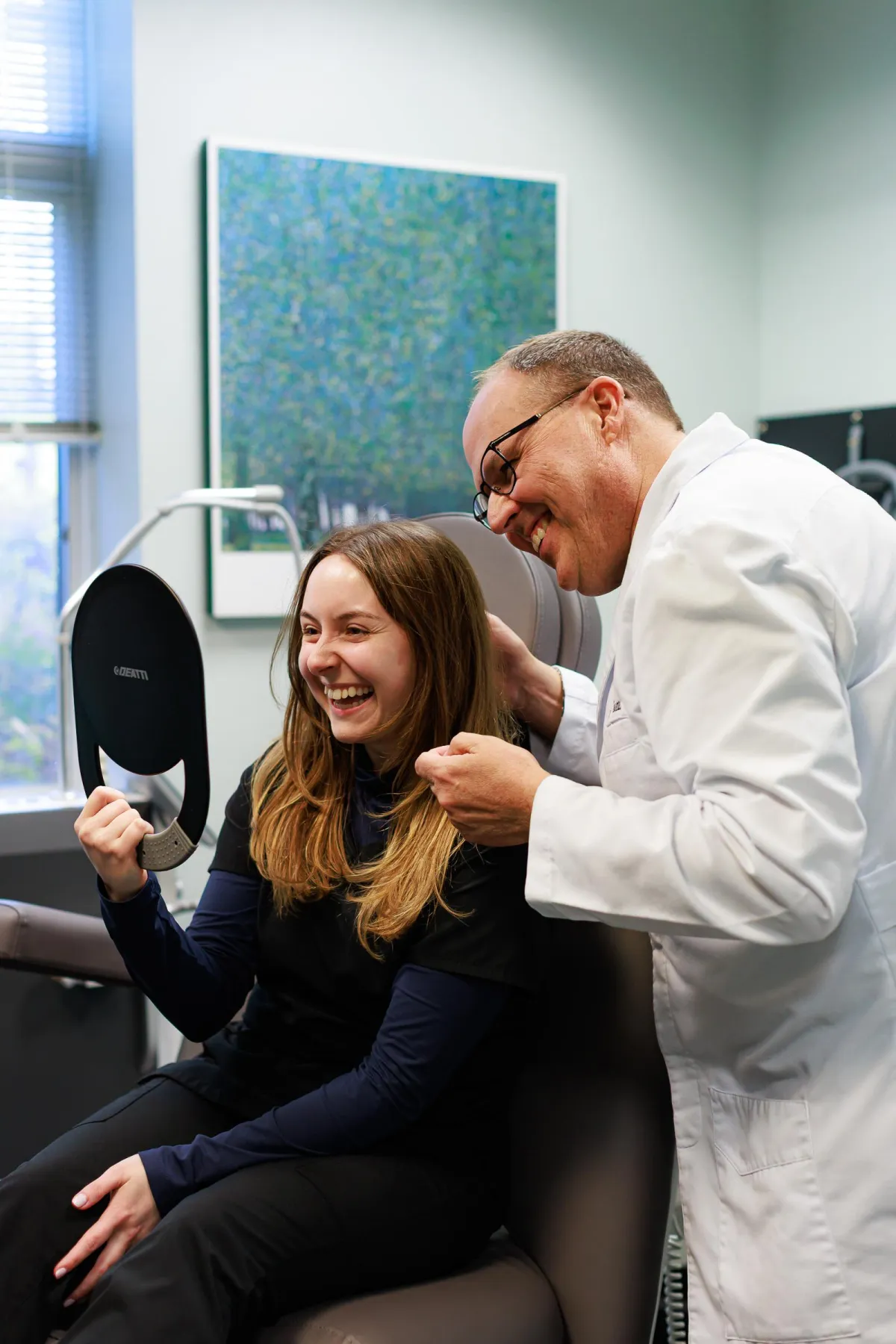
At Physician Artistry, Dr. Thomas brings over 30 years of clinical expertise to every treatment plan. That means you're not walking into a conversation where someone is trying to figure out which package to sell you — you're having a genuine medical conversation about what your face actually needs. Patients regularly describe the experience as "comprehensive and thoughtful" and consistently note that results "enhanced their features without ever looking overdone."
Whether that conversation leads to threads, fillers, a combination of both, or something else entirely — like Secret RF Microneedling to address skin quality before any lifting treatment — you'll leave knowing exactly what you're doing and why.
The Bottom Line
Thread lifts and fillers aren't competing treatments — they're complementary tools that address different aspects of facial aging. Threads offer real mechanical lift for tissue that has descended. Fillers restore the volume that age has taken. Used wisely and in the right combination, they can produce results that look genuinely refreshed rather than obviously "done."
But the most important variable in any of this isn't the product — it's the plan. And a good plan starts with an honest, in-depth conversation with someone who is more invested in your long-term outcome than in filling an appointment slot.
If you're in Sterling, Northern Virginia, or anywhere in the DC metro area and you're ready to have that conversation, we'd love to meet you. Learn more about dermal fillers at Physician Artistry, or reach out to schedule a consultation with Dr. Thomas. There's no pressure, no package to sell — just a straightforward conversation about what's actually going on with your face and what your real options are.