

If you've been researching biostimulators long enough, you've probably landed on a question that most practices won't answer directly: can Sculptra and Radiesse actually be used together? And if so, is it safe?
It's a smart question — and the fact that you're asking it means you've already done more homework than most. You understand that these aren't just fillers. You understand that they work differently from hyaluronic acid products. And now you want to know whether combining them is a sophisticated strategy or an unnecessary risk.
The honest answer: it depends entirely on who's making the decision and why.
First, Let's Get Clear on the Difference Between Sculptra and Radiesse
Both Sculptra and Radiesse are classified as biostimulators — meaning they work by triggering your body's own collagen production rather than simply filling space with a gel. But the difference between Sculptra and Radiesse goes deeper than their ingredients.
Sculptra is made from poly-L-lactic acid (PLLA), a synthetic material that has been used in medicine for decades. It works gradually and diffusely, stimulating collagen over a broad area across several months. Most patients need a series of two to three sessions spaced four to six weeks apart, and full results typically emerge somewhere between three and six months after the final treatment. It's exceptionally well-suited for global facial volume restoration — think overall softening of the face, improved skin quality, and a lifted, more youthful structure that looks like it happened naturally.
Radiesse is made from calcium hydroxylapatite (CaHA) microspheres suspended in a gel carrier. It offers something Sculptra doesn't: immediate structural support. The moment Radiesse is injected, it creates visible lift and definition. Over the following months, the gel carrier is absorbed and the CaHA microspheres stimulate collagen in that specific location. It excels in areas that need precise definition — jawlines, chins, cheekbones, and hands.
So when patients ask whether Radiesse is better than Sculptra, or which is better — Sculptra or Radiesse — the answer is genuinely neither. They're complementary tools. And that's exactly what makes combining them so interesting.
Why a Physician Might Recommend Both
Here's where clinical thinking matters more than marketing language.
Sculptra works beautifully across large surface areas. It rebuilds lost volume diffusely, improving overall skin quality and thickness over time. But it won't give you sharp jawline definition the moment you need it, and it won't provide immediate structural lift in a targeted area.
Radiesse does that second part well — but it's not meant to be scattered broadly across the face. It's a precision instrument.
When used together strategically, Sculptra can address the broader picture — restoring youthful fullness to deflated cheeks, improving overall skin quality, and laying down a foundation of new collagen — while Radiesse handles specific structural concerns like a softening jawline or flattening midface. You're essentially using a wide brush and a fine brush at the same time, each doing the job it's best suited for.
This approach also appeals to patients who want results they can see now alongside results that continue building for months. The Sculptra timeline is notoriously patient-dependent — as the Sculptra results timeline shows, visible changes emerge gradually from month two onward. Radiesse provides the bridge between treatment day and the point where Sculptra's collagen remodeling becomes visible.
Is It Actually Safe to Combine Them?
Yes — when done correctly and by someone with genuine clinical expertise, combining Sculptra and Radiesse is considered safe and is practiced by experienced injectors.
That said, there are real considerations worth understanding:
Injection zones matter. These two products are typically not injected into the exact same anatomical location during the same session. They serve different purposes and are placed differently. Radiesse tends to be used in deeper tissue planes for structural support, while Sculptra is often distributed more superficially and broadly. A physician who understands facial anatomy will keep these placement zones appropriately separated.
Inflammation management is part of the protocol. Both biostimulators trigger a controlled inflammatory response — that's the mechanism behind collagen stimulation. Combining two products that do this simultaneously in the same area would theoretically amplify that response in ways that aren't clinically desirable. Spacing treatments appropriately, or treating different zones in the same session, mitigates this concern.
Not every patient is an appropriate candidate for both. Patients with active skin infections, certain autoimmune conditions, or a history of keloid formation warrant careful evaluation before any biostimulator treatment — let alone a combination approach. A proper consultation includes a health history review, not just a wishlist conversation.
Volume loading requires judgment. Biostimulators are cumulative. They don't just add product — they stimulate your tissue to produce its own collagen. Overcorrecting with too much product across too many sessions can lead to nodule formation or an overfilled appearance over time. This is why the number of vials and the interval between sessions matter, and why this isn't a decision that should be made in a 15-minute chain medspa consultation.
Who Is the Best Candidate for This Combination?
The combination of Sculptra and Radiesse tends to work best for patients who are experiencing multiple simultaneous signs of facial aging — not just one isolated concern.
If you're noticing that your face looks overall flatter and less full than it used to (a global volume loss issue), but you're also seeing specific structural changes like a less defined jaw or softening cheekbones, you're a candidate worth discussing this with. Similarly, patients who have had significant weight loss — including those on GLP-1 medications — sometimes present with diffuse deflation alongside specific structural changes that benefit from both approaches.
Patients who are already familiar with biostimulators and have completed an initial Sculptra series may also benefit from adding Radiesse for targeted structural refinement, rather than layering more Sculptra into areas that need a different kind of support.
If you're newer to biostimulators entirely, it may make clinical sense to start with one and assess your response before layering in a second. Biostimulators are increasingly replacing traditional fillers for good reason, but starting thoughtfully produces better outcomes than trying to do everything at once.
What About Timing — Same Session or Different Appointments?
This is one of the questions patients ask most often, and the honest answer is: it depends on the treatment plan and the anatomy being addressed.
In some cases, Sculptra and Radiesse can be used in the same appointment when they're treating clearly different anatomical zones — for example, Sculptra diffusely across the midface and temples while Radiesse is used specifically along the jawline. This approach is efficient and allows for a cohesive treatment plan with one recovery window.
In other cases, a physician may prefer to stage the treatments — completing a Sculptra series first, allowing initial collagen remodeling to begin, and then evaluating whether targeted Radiesse is still needed for specific areas. This staged approach is especially useful for patients who are uncertain about how much correction they want, since Sculptra's gradual nature allows for natural-looking buildup without overshoot.
There's no universal answer here. What matters is that the sequence is chosen based on your individual anatomy and goals — not what happens to be convenient on a given day.
How Does This Compare to Just Using More Filler?
This is worth addressing directly, because many patients come in having had hyaluronic acid filler placed over several years and are wondering whether to continue that approach or shift to biostimulators.
Traditional fillers add volume immediately, which is their strength. But they require ongoing maintenance, can migrate over time, and don't address the underlying loss of collagen scaffolding that causes aging in the first place. Many repeat filler patients are switching to biostimulators precisely because they want results that feel more structural and less dependent on constant top-ups.
Combining Sculptra and Radiesse sits in a different category altogether — you're investing in your own tissue's capacity to regenerate, not just importing volume from the outside. The results tend to integrate more naturally with your existing facial structure because they are your facial structure, rebuilt and reinforced.
That said, biostimulators alone aren't always sufficient. Patients with significant structural loss may still benefit from some hyaluronic acid filler in certain areas, and the question of whether biostimulators are enough alone deserves an honest answer based on your specific anatomy.
What to Expect If You Move Forward with Both
Practically speaking, here's what a combined Sculptra and Radiesse treatment experience typically looks like:
Consultation first, always. A physician should review your full health history, assess your facial anatomy in detail, and create a written treatment plan before any product is ordered or injected. This is where the difference between a physician-led practice and an injection mill becomes apparent.
Downtime is real but manageable. Biostimulators involve more post-treatment massage protocol (particularly Sculptra, which requires the 5-5-5 massage rule) and more initial swelling than some HA fillers. Planning your first treatment when you don't have a major event within the next two weeks is wise.
Results are cumulative. Neither Sculptra nor Radiesse delivers its full effect immediately. Radiesse shows more immediately, but the collagen-stimulating results of both products continue building over three to six months. Patience isn't just advisable — it's part of the mechanism.
Maintenance is less frequent than filler. One of the reasons patients choose biostimulators is that the results — once established — tend to last longer than traditional fillers. Sculptra results often last two years or more. Radiesse typically lasts twelve to eighteen months in most patients. Combining them doesn't shorten that timeline.
The Physician Artistry Approach
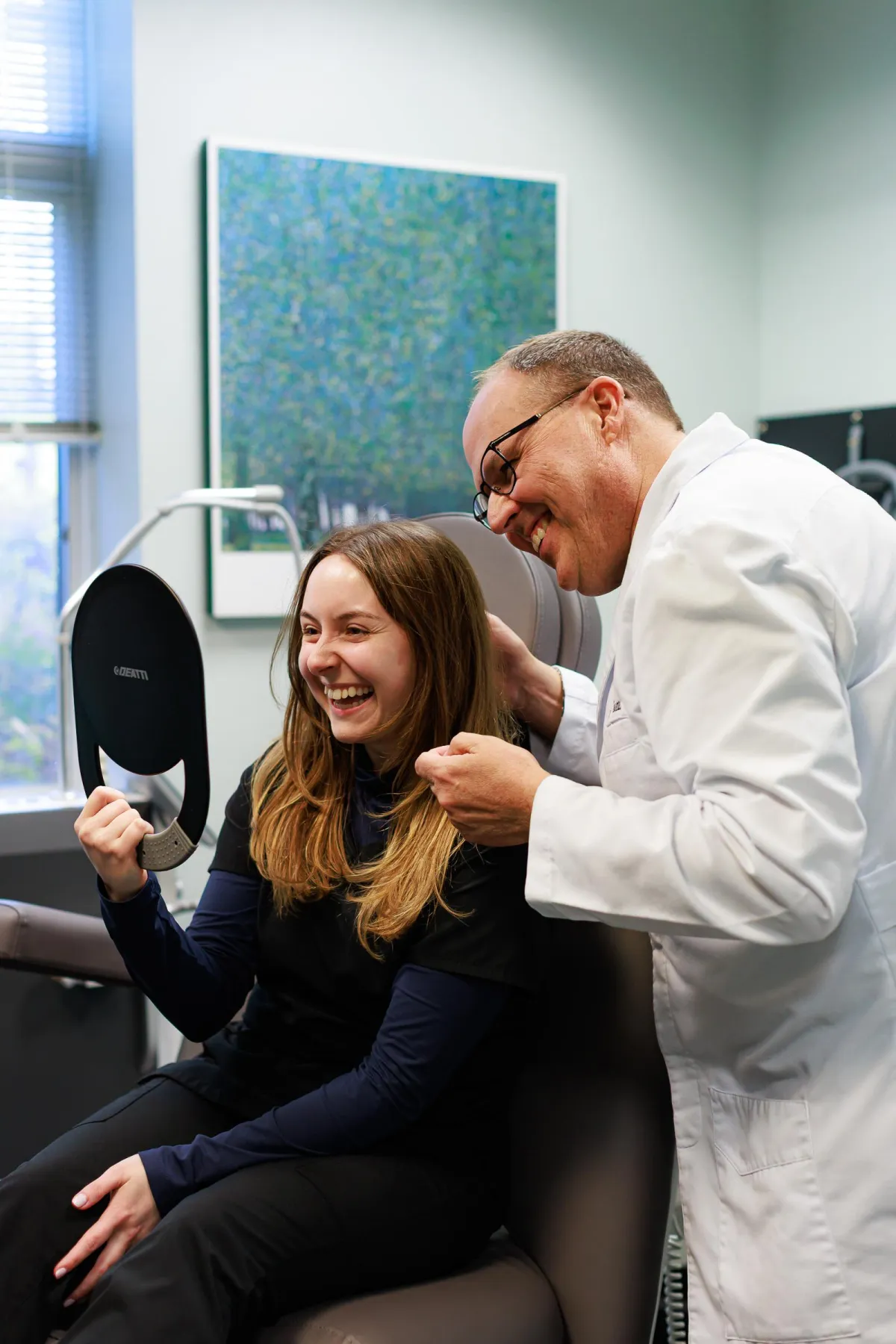
At Physician Artistry in Sterling, VA, Dr. Thomas brings over 30 years of clinical expertise to every biostimulator consultation. This isn't a decision made by a tech reading from a protocol checklist — it's a physician-level evaluation of your anatomy, your history, and your goals.
What patients consistently describe is a "comprehensive and thoughtful approach" — one where the goal is never to sell a particular product combination, but to build a treatment plan that genuinely makes sense for how your face is aging and what you want to preserve. Results that "enhanced features without ever looking overdone" are the standard here, not the exception.
If you're curious whether combining Sculptra and Radiesse makes sense for you specifically, the next step is a real conversation — not a generic quiz or an online booking form. Come in, sit down with Dr. Thomas, and talk through what you're noticing and what you want. That's where the right answer actually lives.
Ready to explore your options? Learn more about biostimulator treatments at Physician Artistry or call us to schedule a consultation in Sterling, VA.

Start your transformation today!
Schedule your complimentary consultation with our friendly and knowledgeable team.