
There's a moment that happens for a lot of patients in their early 60s. They've been getting fillers for years — maybe a syringe here, a touch-up there — and somewhere along the way, the results started feeling a little off. Not bad, exactly. Just not quite right. The face looks a little heavier, or the treatment feels like it's doing less than it used to. And they're not wrong. What worked beautifully at 45 isn't the whole picture at 62.
That's not a criticism of fillers. Fillers are still one of the most useful tools in aesthetic medicine. But after 60, the changes happening in your face are more layered than volume loss alone — and treating only one piece of a multi-part puzzle will always leave something missing.
Here's what's actually going on, and what a smarter approach looks like.
Your Face at 60 Is a Different Equation
Aging after 60 involves at least four things happening at once: collagen and elastin breaking down, bone structure subtly shifting, facial fat redistributing or shrinking, and skin quality — texture, tone, and tightness — declining across the board. Filler addresses volume. But it doesn't rebuild collagen, retighten loose skin, or improve texture.
This is why patients who've been loyal filler patients for years sometimes start noticing that they need more product to get the same result, or that the results feel heavy rather than refreshed. If the structural foundation isn't being supported and the skin quality isn't being addressed alongside volume replacement, filler alone starts to work against you over time. Repeat filler patients are increasingly discovering this shift — and finding that biostimulators and skin-tightening treatments fill in the gaps that straight filler can't.
What Actually Changes After 60
Let's walk through the real picture, because understanding your face helps you make better decisions about it.
Collagen loss accelerates. You lose about 1% of your collagen per year starting in your 30s. After menopause, that rate can jump significantly — some studies suggest up to 30% of remaining collagen is lost in the first five years post-menopause. By your 60s, you've accumulated decades of that loss, and topical products — even good ones — don't have meaningful access to the deeper layers where collagen lives.
Bone remodeling continues. The facial skeleton actually shrinks and shifts over time. The jaw narrows, the eye socket widens, and cheekbone projection decreases. This changes the scaffolding your soft tissue sits on — which is part of why jowling and midface descent happen even in patients who've never had any work done.
Skin quality changes in ways volume can't fix. Laxity, crepiness, enlarged pores, uneven texture — these aren't solved by filling space. They require treatments that actually work at the tissue level to stimulate new collagen, tighten, and resurface.
Fat compartments redistribute. Some areas lose fat (the temples, cheeks, and undereye area). Others can accumulate it (the jowl area, the lower face). This redistribution changes the whole geometry of the face, and adding volume in the wrong places can make it look heavier rather than younger.
The Treatments That Actually Move the Needle After 60
At Physician Artistry, we see a lot of patients in their 60s and beyond who come in having had a good experience with fillers elsewhere — but who want results that feel more complete. What we typically build for these patients is a layered plan that addresses skin quality, structure, and volume together.
Secret RF Microneedling. This is one of the highest-impact treatments we offer for patients over 60. Secret RF Microneedling uses radiofrequency energy delivered through microneedles to reach the deeper layers of the skin — stimulating real collagen production, tightening lax tissue, and improving texture and tone. It works in ways that topical skincare simply cannot. Patients who have been dealing with crepey skin, loose jowls, or general dullness often see meaningful changes over a series of treatments. Patients frequently ask whether RF microneedling is worth it — and for skin that's lost structural support, it consistently delivers results that fillers alone don't.
Biostimulators like Sculptra and Radiesse. Rather than simply filling a space, biostimulators work by triggering your own collagen production. Sculptra, in particular, works gradually over months — building real tissue support rather than just displacing it. The results develop over months 1 through 6, and the payoff is a more natural, structural improvement than you'd get from filler alone. For patients in their 60s who feel like they've been chasing volume, biostimulators often become the more satisfying long-term strategy.
Targeted fillers, used strategically. Fillers still belong in the toolkit — they're just not the whole toolkit. Patients over 60 can absolutely still benefit from dermal fillers when they're placed thoughtfully and as part of a broader plan. The key difference is using them to support structure and restore proportion — not just to add volume wherever things look sunken. Understanding what actually changed your face shape matters enormously when deciding where and how much to treat.
Neurotoxin (Botox, Daxxify, Dysport). After 60, neurotoxin continues to play an important role — not just for dynamic wrinkles, but for repositioning and subtle lifting. A strategic brow position and lid treatment with Botox can open up the eye area meaningfully without surgery. The right neurotoxin for your goals and biology matters — and for patients who want longer intervals between appointments, Daxxify's extended duration is worth a conversation.
Skin resurfacing. Fraxel laser and IPL treatments address the surface-level changes that accumulate over decades — brown spots, uneven tone, sun damage, texture irregularities. These aren't vanity treatments; they're genuine skin health treatments. Fraxel laser and IPL Photofacial work on different mechanisms and are often combined thoughtfully based on what a patient's skin actually needs. Treating brown spots and age spots is one of the most noticeable quality-of-life improvements patients report — often more impactful than they expected.
Why a Physician-Led Plan Makes a Difference Here
This is the part that matters most, and it's not something every med spa can honestly offer. When the treatment plan involves multiple modalities, sequenced over time, the judgment calls get more complex. Which comes first — the skin tightening or the filler? How much volume is appropriate given what's already there? Are the changes you're seeing from aging, or from previous treatments that need to be addressed before moving forward?
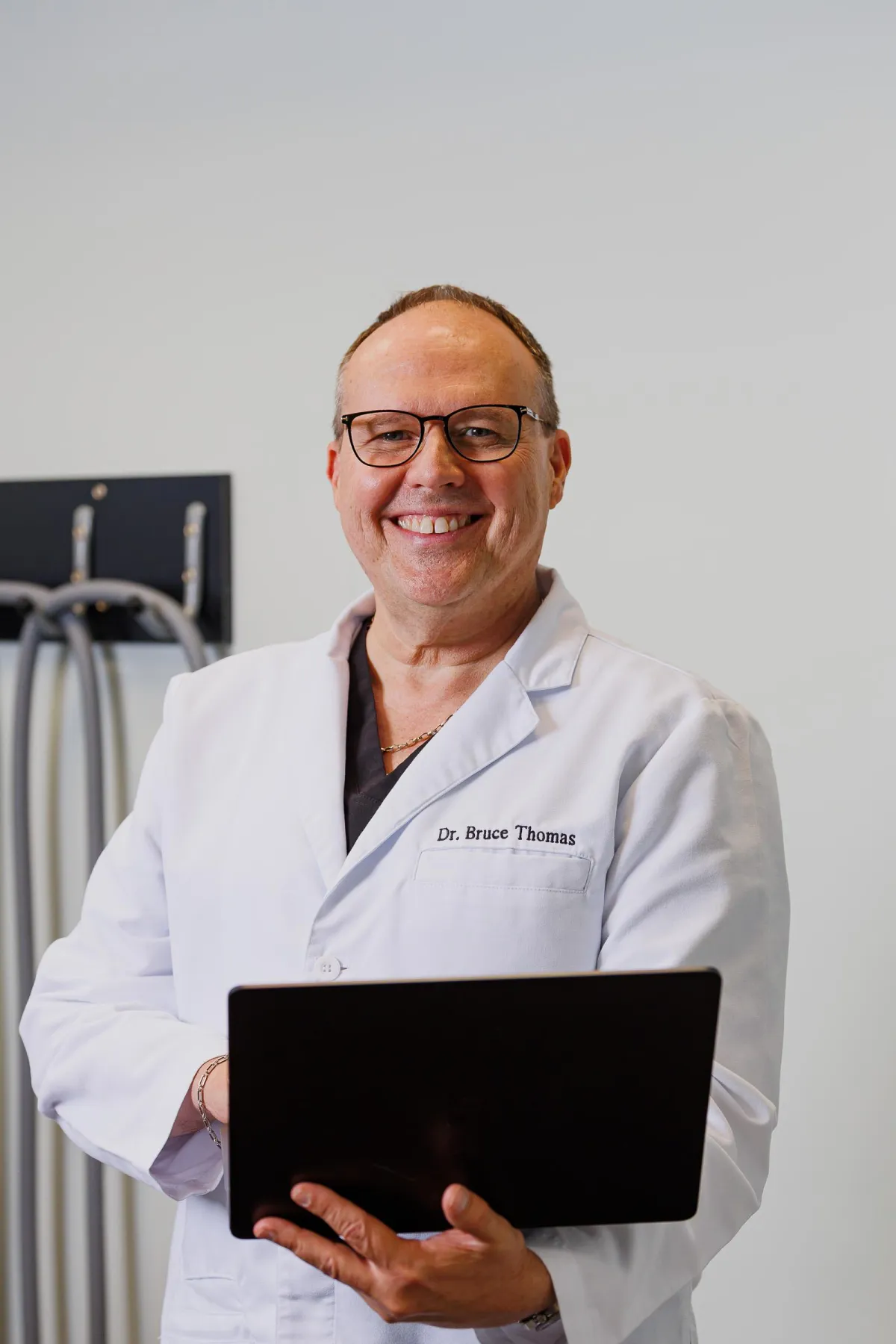
At Physician Artistry, Dr. Thomas personally oversees every treatment plan. With over 30 years of clinical experience in aesthetic medicine, he brings a level of diagnostic depth to these conversations that goes beyond which product is trending. Patients consistently describe a "comprehensive and thoughtful approach" — and that's exactly what treating a 60-year-old face well requires. It's not one product. It's a plan.
Building a personalized treatment plan that's right for where your face is now — not where it was a decade ago — is where the real difference shows up in results.
How to Think About Sequencing
If you're starting fresh or reconsidering your current approach, here's a general framework that works well for patients in their 60s:
First, address skin quality. If the canvas isn't in good shape, everything placed on top of it is limited by that foundation. RF microneedling, resurfacing, and appropriate skincare support come first or run parallel to injectables.
Second, support structure before adding volume. Biostimulators that build collagen gradually create a better foundation for any filler that follows. Rebuilding collagen is a slower game, but the results feel more natural and tend to last longer.
Third, place fillers strategically and conservatively. The goal is proportion and balance — not maximizing volume. Facial balancing as a concept matters more after 60 than at any other decade, because the margin between refreshed and overdone narrows.
Finally, maintain with neurotoxin and plan ahead for touch-ups. Results from biostimulators build over months. RF microneedling benefits compound with repeat treatments. Maintaining your results year-round with a seasonal approach is more efficient and more cost-effective than starting from scratch each time.
The Honest Conversation About Results
You deserve to know what's realistic. After 60, aesthetic treatments can genuinely improve the way you look and feel — patients regularly describe feeling "like myself again, energized and confident." But the goal isn't to look 40. It's to look like the best version of yourself at the age you actually are. That's a different target, and it's actually a more achievable and more satisfying one.
The treatments available now — RF microneedling, biostimulators, precision neurotoxin placement, strategic filler — are genuinely capable of delivering meaningful results for patients in their 60s and beyond. Non-surgical treatments for sagging skin after 50 and 60 have come a long way, and the results, when done well, are real.
What makes them work is the plan behind them — and the physician who builds it.
If you're in Sterling, VA or the broader Northern Virginia and DC metro area and you're ready to have that honest conversation about what your face actually needs right now, we'd love to meet you. The consultation is where everything starts — and where patients almost always leave feeling more informed and more hopeful than when they walked in.
Start your transformation today!
Schedule your complimentary consultation with our friendly and knowledgeable team.