

You already know stress doesn't feel good. But here's what most people don't realize: it doesn't look good either. And we're not talking about the tired eyes after a rough week. We're talking about real, measurable changes to your skin that accumulate quietly over months and years — the kind that make you look in the mirror one day and wonder when exactly that happened.
If you've been under sustained pressure — a demanding job, a health scare, caregiving, a major life transition — and you've noticed your skin looking older, duller, or just off, that's not your imagination. There's a direct biological reason for it. And the good news is, it's addressable.
What Cortisol Actually Does to Your Face
Cortisol is your body's primary stress hormone. In short bursts, it's useful — it helps you respond to threats, stay sharp, and recover. But when it stays elevated for weeks or months at a time, it starts working against you in ways that show up clearly on your skin.
Here's what chronic cortisol elevation actually triggers:
Collagen breakdown accelerates. Cortisol suppresses the fibroblasts responsible for producing collagen. Less collagen means skin loses its firmness and elasticity faster than it naturally would with age alone. Lines deepen. Skin starts to sag sooner than expected.
Inflammation increases. Stress drives up systemic inflammation, which breaks down the skin barrier, worsens conditions like rosacea and acne, and contributes to an uneven, reactive complexion. If your skin has become more sensitive or prone to flare-ups during stressful periods, this is why.
Skin becomes drier and duller. Cortisol disrupts the skin's lipid barrier, reducing its ability to retain moisture. The result is skin that looks flat, tired, and lackluster — even when you're sleeping enough and drinking water.
Facial volume shifts. Prolonged stress affects fat distribution, including in the face. You may notice hollowing under the eyes, reduced fullness in the cheeks, or a general deflated quality that wasn't there before.
Muscle tension etches lines deeper. Chronic stress keeps the muscles of your face — especially around the brow and jaw — in a near-constant state of tension. Over time, this repetitive contraction deepens the lines between your brows, across your forehead, and around your mouth faster than relaxed muscle movement would.
Sleep disruption compounds everything. Poor sleep raises cortisol further and reduces the overnight repair processes your skin depends on. It's a cycle that feeds itself.
The result of all of this, when sustained over time, is a face that looks older, more tired, and less vibrant than you feel on the inside — or than you want to feel.
Does Stress Actually Age Your Face? Yes — and Here's the Research
This isn't anecdotal. Studies on identical twins have shown that the twin who experienced higher chronic stress showed measurably more visible aging — more wrinkles, more laxity, more hollowing — than their genetically identical sibling. Psychological stress is now well-documented as an accelerant of biological skin aging, operating through the cortisol pathway, oxidative stress, and shortened telomeres.
What that means practically: stress isn't just making you feel older. It is making you older, at a cellular level, and your face reflects that.
What Med Spa Treatments Can Actually Do
Here's the important distinction: managing stress is essential, and no med spa treatment replaces sleep, rest, or whatever helps you decompress. But the physical changes that stress creates in your skin — the collagen loss, the volume depletion, the deepened lines, the inflammatory damage — those are real structural problems that lifestyle changes alone won't reverse. That's where targeted aesthetic treatments make a genuine difference.
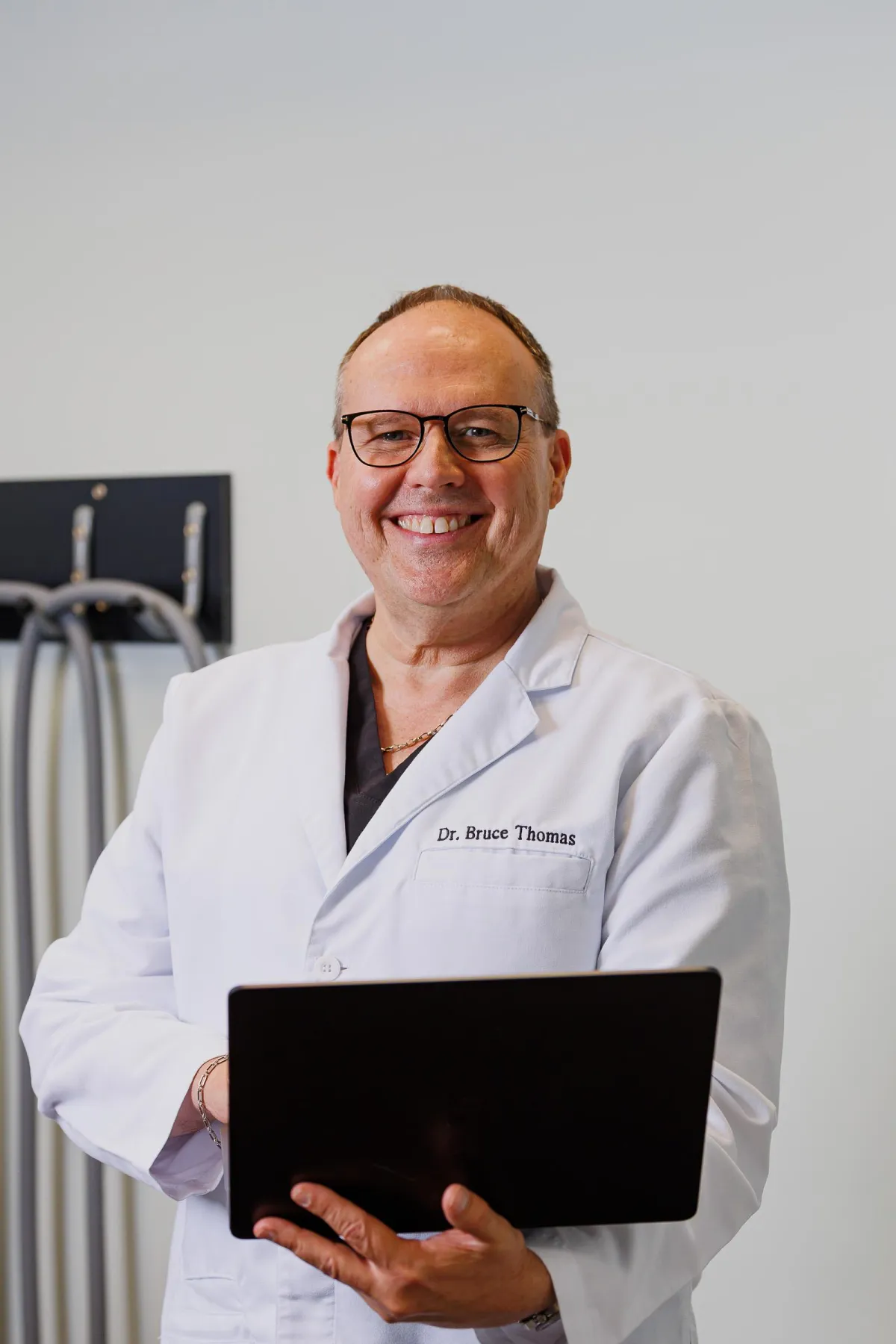
At Physician Artistry in Sterling, VA, Dr. Thomas takes a comprehensive approach to stress-related skin changes — looking at the full picture rather than chasing individual symptoms. With over 30 years of clinical experience, he understands that what shows up on your face is often a reflection of what's been happening in your body. The treatment plan follows from that assessment.
Here's what tends to make the biggest difference for patients dealing with stress-driven aging:
Neurotoxin (Botox/Dysport/Daxxify) for Tension Lines
Chronic muscle tension from stress is one of the most direct contributors to premature line formation — especially between the brows, across the forehead, and around the eyes. Botox and related neurotoxins relax the muscles responsible for those repeated contractions, giving the skin a chance to soften and, over time, preventing those lines from etching deeper. For patients who want longer intervals between appointments, Daxxify may last noticeably longer than Botox — worth discussing during your consultation.
Many patients also don't realize that jaw tension from stress can contribute to teeth grinding and a widened, square jaw appearance — something that masseter Botox addresses directly, relieving both the aesthetic and physical discomfort.
Dermal Fillers for Volume Restoration
Stress-accelerated collagen loss and fat redistribution leave the face looking hollow and deflated — particularly under the eyes, in the midface, and along the jawline. Dermal fillers restore that lost volume strategically, without the overfilled look that makes results obvious. When placed by a physician with real aesthetic judgment, the goal is simply to look like yourself again — rested, not altered.
If stress has affected your under-eye area specifically — hollowing, shadowing, that sunken appearance that no amount of sleep seems to fix — under-eye filler for dark circles and tear troughs is worth exploring.
Secret RF Microneedling for Collagen Rebuilding
Because stress directly suppresses collagen production, one of the most meaningful things you can do is actively stimulate new collagen from the inside out. Secret RF Microneedling delivers radiofrequency energy into the deeper layers of the skin, triggering a controlled healing response that builds genuine collagen over the following weeks and months. Patients consistently notice firmer, smoother, tighter skin — and the improvements continue to develop even after the treatment series ends.
For patients dealing with stress-related texture changes, scarring from stress-triggered acne, or general laxity that's appeared ahead of schedule, RF microneedling addresses multiple concerns simultaneously.
Biostimulators for Long-Term Collagen Support
For patients whose stress-driven aging has led to more significant volume and structural changes, biostimulators like Sculptra offer a different approach than traditional fillers — stimulating your own body to produce collagen gradually over time, with results that build naturally and last longer. If you've been relying on filler for years and feel like it's not doing enough anymore, this is why many patients are making the switch.
Skin Quality Treatments for Inflammation and Dullness
Cortisol-driven inflammation often shows up as persistent redness, uneven tone, rough texture, and skin that just looks tired regardless of what you put on it. A HydraFacial can help clear congestion and restore surface radiance, while an IPL Photofacial targets redness, brown spots, and the uneven pigmentation that inflammation accelerates.
For deeper skin quality restoration, polynucleotide injections are gaining significant traction as a way to rehabilitate skin quality at a cellular level — particularly for patients whose skin has lost its glow and resilience over time.
Hormone Considerations
One factor that's frequently overlooked in stress-related skin aging: the relationship between chronic stress and hormonal disruption. Elevated cortisol suppresses estrogen and testosterone — and both of those hormones play a critical role in skin thickness, collagen density, and hydration. If you're also experiencing hormonal shifts from perimenopause or other causes alongside chronic stress, the two compounds each other significantly.
Dr. Thomas's background in hormone therapy means this dimension is part of the conversation when it's relevant — not siloed away as a separate concern. Hormonal skin changes in your 40s and 50s and stress-driven changes often need to be addressed together for the most complete results.
Treating Combination Issues
It's worth noting that stress rarely creates just one type of skin change — it creates several at once. That's why a single treatment rarely tells the full story. Combining treatments in a thoughtful sequence is typically how patients see the most meaningful and lasting results. Dr. Thomas builds plans around your specific presentation, not a one-size-fits-all menu.
What Patients at Physician Artistry Say
Patients consistently describe a care experience that goes beyond the treatment room. "He continues to check in on me, even after major milestones," one patient noted. Another described results that "enhanced my features without ever looking overdone." That kind of attention — the kind that tracks your progress and keeps your long-term wellbeing in view — is what makes the difference between a result that looks right and one that just looks done.
You Don't Have to Keep Wearing Your Stress on Your Face
Stress may be unavoidable in the life you're living. But the mark it leaves on your skin doesn't have to be permanent. If you've been noticing changes — lines that appeared faster than expected, volume that seems to have quietly disappeared, skin that looks tired no matter what — there's a clear path to addressing it. It starts with a conversation.
Physician Artistry is located in Sterling, VA, serving patients throughout Northern Virginia, the DC metro area, and Loudoun County. To schedule a consultation with Dr. Thomas, call the practice or book directly online.
Start your transformation today!
Schedule your complimentary consultation with our friendly and knowledgeable team.